The opinions expressed in this article are deeply personal and do not reflect the views of the organisation I work for.
Disclaimer: I write this as an early career scientist, with great respect for Tim Palmer and his decades of contributions to the field. I do not claim to match his experience or breadth of knowledge, and I may well be wrong on some points. My aim is to add one more perspective to the discussion.
At a recent talk by Tim Palmer, he described his vision of establishing a CERN-like modeling center somewhere in the world. It would pool resources to simulate the global climate at an ambitious 1 km resolution, which he suggested could help solve the climate crisis. He opened the talk by citing his article in The Economist (https://www.economist.com/by-invitation/2026/08/30/the-world-may-have-less-time-than-it-thinks-on-climate-change). The only thing he said he disliked about the article was its cover picture (attached below for the benefit of reader), which is supposed to be of him. I disagree with him there: the picture is the part I like most. I do, however, have many reservations about the opinion piece itself.

Source: The Economist
Climate change is one of the biggest challenges humanity faces today. It disproportionately affects people in underprivileged societies, who suffer the most damage. Coming from one of the most marginalised societies in India, I cannot sleep some nights without thinking about the climate crisis. We need to address it now, and on this, Tim Palmer and I agree passionately.
The “CERN for climate” argument:
Tim argues that the climate modeling community has not done enough to address climate change. He is critical of CMIP models and believes that using them for climate adaptation is flawed and unlikely to solve the crisis. I understand that he does not necessarily mean CMIP is bad, or that the IPCC, which bases its reports on CMIP, is flawed. But his argument builds towards the point that we need kilometer-scale global models to better resolve the dynamics of fluid flow. In his view, far less attention has been paid to future changes in circulation than to the thermodynamics of climate change. It is undeniably true that we need to resolve fluid flow as well as we can using the Navier–Stokes equations. But climate modeling is more than that.
Why resolving fluid flow is essential but not sufficient:
Climate models must resolve fluid flow at high resolution (1 km is a sweet spot, according to Tim), and there is no two ways about it. However, climate models are also very complex in the physics they use to represent sub-grid processes. Turbulence, for example, occurs at scales from micrometers to kilometers. We must parametrize the unresolved part and feed it back to the resolved flow by coupling the physics with the dynamics. Other parametrizations include cloud microphysics, radiation, sub-grid orography, and orographic drag. To Tim’s credit, some of these schemes owe a great deal to his work.
Even at 1 km horizontal resolution, however, climate models show biases very similar to those of their coarse-resolution counterparts. I call these structural and systematic model biases. Kilometer-scale models improve some aspects of the simulated climate, but the structural biases often remain. Notable examples in some of the major kilometer-scale efforts are the representation of ENSO and the MJO. I have deliberately not singled out specific projects, since these are large collaborative efforts and my aim is to discuss the approach, not any one group. The relevant results are openly published, and I am happy to point interested readers to them.
In the talk, he highlighted two examples where km-scale models resolved some structural biases. He did not discuss the biases that remain.There may be many reasons for them, but I suspect much of it comes from the physics, or from the coupling of physics and dynamics, which needs immediate attention. The parametrizations still used in kilometer-scale models carry uncertainties, and these are causing the structural biases.
A bottom-up, inclusive approach to the climate crisis:
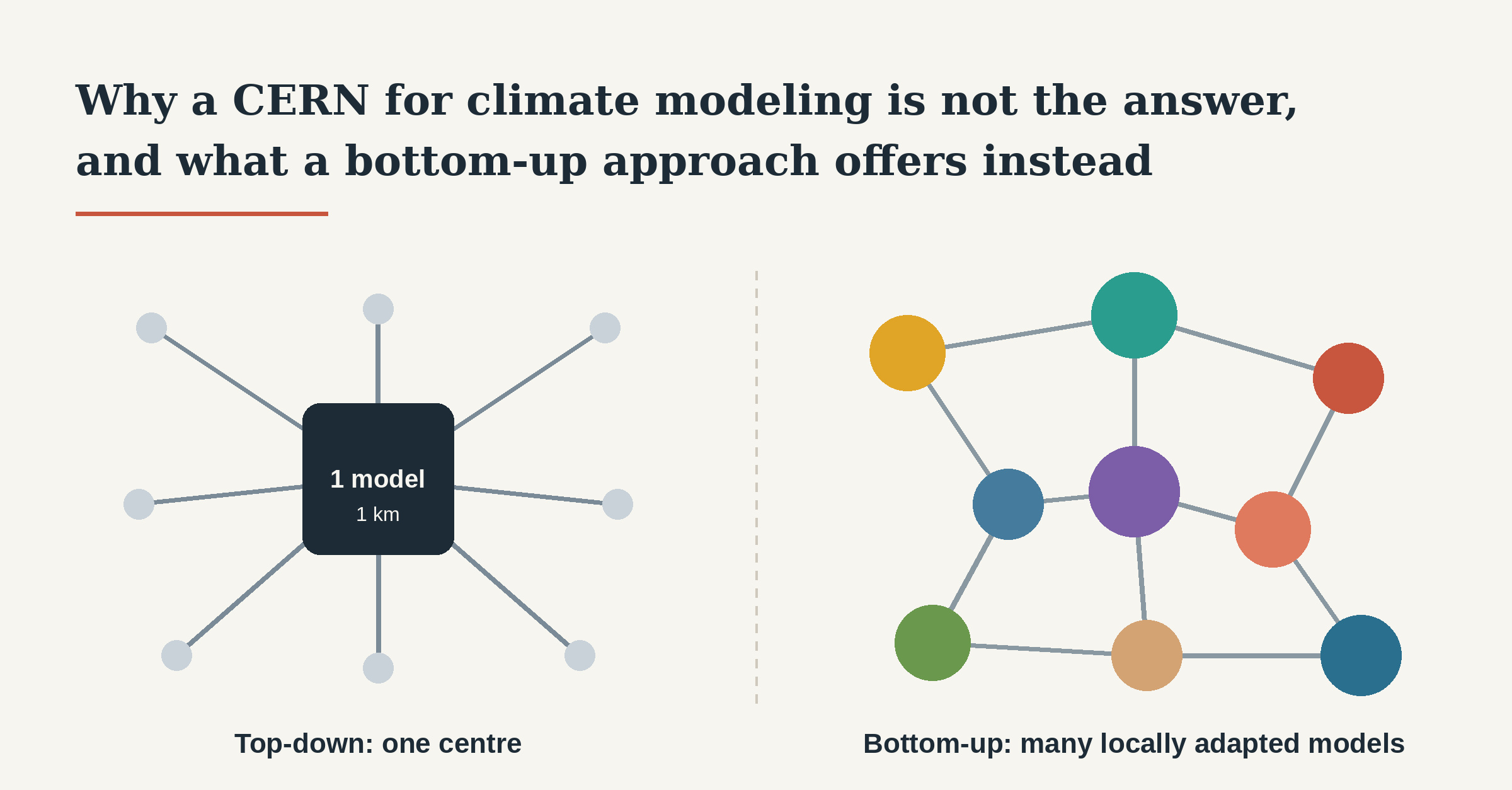
Tim proposes developing a single model at a CERN for climate change, with stochastic perturbations providing the ensemble spread. I call this a top-down approach: one center pools all the major resources (whoever might fund it) to build a high-performance facility capable of simulating the climate. This centralises the resources and the talent pool, in the hope of resolving the climate crisis.
I believe this unified approach is a high-risk project with low potential for meaningful results. Climate change and adaptation are diverse and highly localised problems. Every country, state, and region faces unique challenges that need to be addressed. Solving them requires a bottom-up approach: many centers operating at the local level, using a diverse set of models that can together account for uncertainties. One successful example is the CORDEX initiative, a set of regional models applied to specific regions. These can be tuned for particular purposes and needs, providing valuable climate information for adaptation. The regional approach also brings in the perspectives of stakeholders, since climate decisions are ultimately taken at a very local level. My understanding is that the kilometer-scale modeling community sees global km-scale models as a replacement for regional downscaling efforts such as CORDEX, not a complement to them. This is the point on which I most disagree.
If, in the near future, the well-resourced CMIP modeling centers push their resolution to near 5-10 km globally, and if we can downscale these models to hyperlocal levels, I believe we can make informed decisions to tackle climate change. Climate adaptation is about making the best decisions under uncertainty, and that requires a range of plausible outcomes, not a single answer. A diverse set of models, built on different structural assumptions, provides that range. Stochastic perturbations within a single model cannot fully provide it, because they do not sample the structural uncertainty in the physics itself. I also believe a regional, multi-model approach would be inclusive, enabling knowledge transfer from local communities to global modelers and vice versa. With tools like GPTs, it is becoming possible to write new climate models (dynamical or AI based), or to adapt existing ones, at regional scale. I hope that countries and regions such as India, Indonesia, South America, and Africa can build their own models, using the physics they think best suits their region. This would add genuine diversity to the model ecosystem. This does not require a central facility. It requires countries to invest in their own modeling capacity, supported by open-source tools and openly shared results, so that each region owns its modeling choices.
Being more democratic:
Perhaps it would also be much more affordable than a CERN for climate change and, importantly, more democratic, since modeling choices would be spread across many regions rather than concentrated in one center. It would also be more resilient. A single facility depends on one site, one funding arrangement, and the continued cooperation of its member states, and political circumstances can change. A distributed network of locally adapted models can lose a node without losing the whole capability.
Thank you,
Praveen


